
4 lessons for recruitment leaders now
I speak to hundreds of recruitment leaders.
Behind the brave faces, many are worried, unhappy and deeply uncertain about the future. There is no crime in that!
The market is soft, and the entire recruitment landscape is changing so fast.
How you respond as a leader is the key.
You haven’t truly tested your leadership until you’ve led through a downturn or a period of existential uncertainty. Like now. Here are four leadership disciplines that matter in every market but become critical when times are tough.
1: Laser-like Focus
Falling revenue and customers leaving can make it easy to lose focus. I believe in specialisation. Carving out a series of niches gives you power in good times and is highly defensive in bad. My business mantra has always been, “We are a mile deep and an inch wide”.
The winners in this changing market will narrow their business portfolios. Do not try to become all things to all people.
Generalists are compared on price. Specialists are compared on insight.
Do not rely on ‘market recovery’ to restore lost margins. You must walk away from bad business. Respectfully ‘fire’ bad clients who waste your time and do not appreciate your value.
Many employers are reducing recruitment agency usage, but they are increasingly relying on fewer, niche, higher-quality agencies.
The market is not collapsing. It is getting more selective.
As a leader, you must encourage the business to focus on just a few critical priorities that you know will drive revenue.
That could be many things, but it may be as simple as (and these are just examples; yours will be different)
1) Grow temp sales in the SAP tech sector.
2) 70% of our recruiter time must be on face-to-face or verbal customer contact.
3) We only work on qualified, exclusive job orders.
These are clear business priorities. They give your team focus. Leadership must ensure that always. But when the market and the future are uncertain, like now, it’s a matter of survival!
2: Bring People Together
When the pressure is on, recruiters often become defensive and territorial. Your teams start seeing internal colleagues as threats. (much more likely to happen when people work remotely). When that happens, they lose sight of what really matters. Customers.
Leaders must stop this self-destructive behaviour from catching on.
Lead by getting closer to your people than ever before.
If you think you are nervous about the future, how do you think your recruiters feel? Create certainty where you can. Communicate more often — not just in crises.
Be present and available. Attend meetings to listen in. Be ‘slow to understand’. Make no assumptions. Don’t preach. Listen and contribute.
Spend as much time as possible with your staff on the job: running job meetings, taking training sessions, going on client visits. Don’t hide yourself in your office or your corner.
Be more visible, not less visible.
Encourage people to work together actively. That could include joint meetings of temp and perm teams to share ideas. It could mean encouraging people from different teams to go on joint visits. Alternatively, you could get a real ‘gun’ recruiter from one part of the business to share her success ideas with those from another. Small steps, but important ones, to keep people aligned on the common goal. Winning business. Delivering outcomes.
3: Train. Coach. Teach. Support
The recruiter capability gap is widening! Most recruiters cannot operate at an advisory level. AI will expose this, not fix it.
Here is an inconvenient truth that may make you uncomfortable.
If your consultants do not bill enough. If they are not motivated. If their skills are weak. If they leave…
That is a leadership responsibility.Yours.
Training is no longer optional — it is existential.
Increase investment in skills. I don’t mean more training on yesterday’s recruitment techniques. I mean developing recruiters who can challenge a brief, advise on hiring strategy, interpret market intelligence, influence clients and build relationships that AI cannot replicate. Recruiters who bring judgement, not just candidates. That’s where the investment must go.
During the 2010 downturn, business was tough at Firebrand Talent Search. My team mantra was more face-to-face client visits. I did 100 visits that year myself, and I was CEO. That’s just two a week. And mostly, someone else arranged the visit. But a good example was set, and I felt useful too, because seeing clients is my sweet spot. And I always took team members with me to those meetings. I learned each recruiter’s ability to build rapport and gauge the mood. It led to training, feedback, and improvement. It was invaluable, and years later, team members from that time told me the same.
4: Staff engagement. Build trust
It’s crucial to open a dialogue with your teams during challenging times. Don’t leave them in the dark. Lack of information breeds uncertainty and pulls focus from the job at hand. As you make changes, make sure people understand your decisions and why.
So, at Recruitment Solutions and, many years later, at Aquent, these were some of the actions I learned that I think kept people engaged.
Constant communications, including mailing of results, successes, and updates.
In-person or video ‘Fireside chat’ where I explained changes, shared results, and gave updates. Very powerful.
Dedicated training sessions to deal with changed market conditions. Not more of the same old stuff, but bespoke tactics for what they were dealing with now!
Individual informal chats with team members to gauge where they are, offer support, and help them succeed. Even more important when people are often ‘remote’
Celebrate the small victories publicly. Mix it up – make it fun.
Normalise uncertainty — Don’t deny it. Do not pretend it’s all fine when it clearly is not. Coach people to thrive on change, to be nimble and to embrace the fact that sacred cows may need to be slaughtered in a brave new recruiting world.
As I have said many times, leadership is action, and your actions will powerfully affect morale and motivation during these uncertain times.
Your people are watching. Not just what you say, but what you do. Especially now.
*************************************************************************************************************************************************
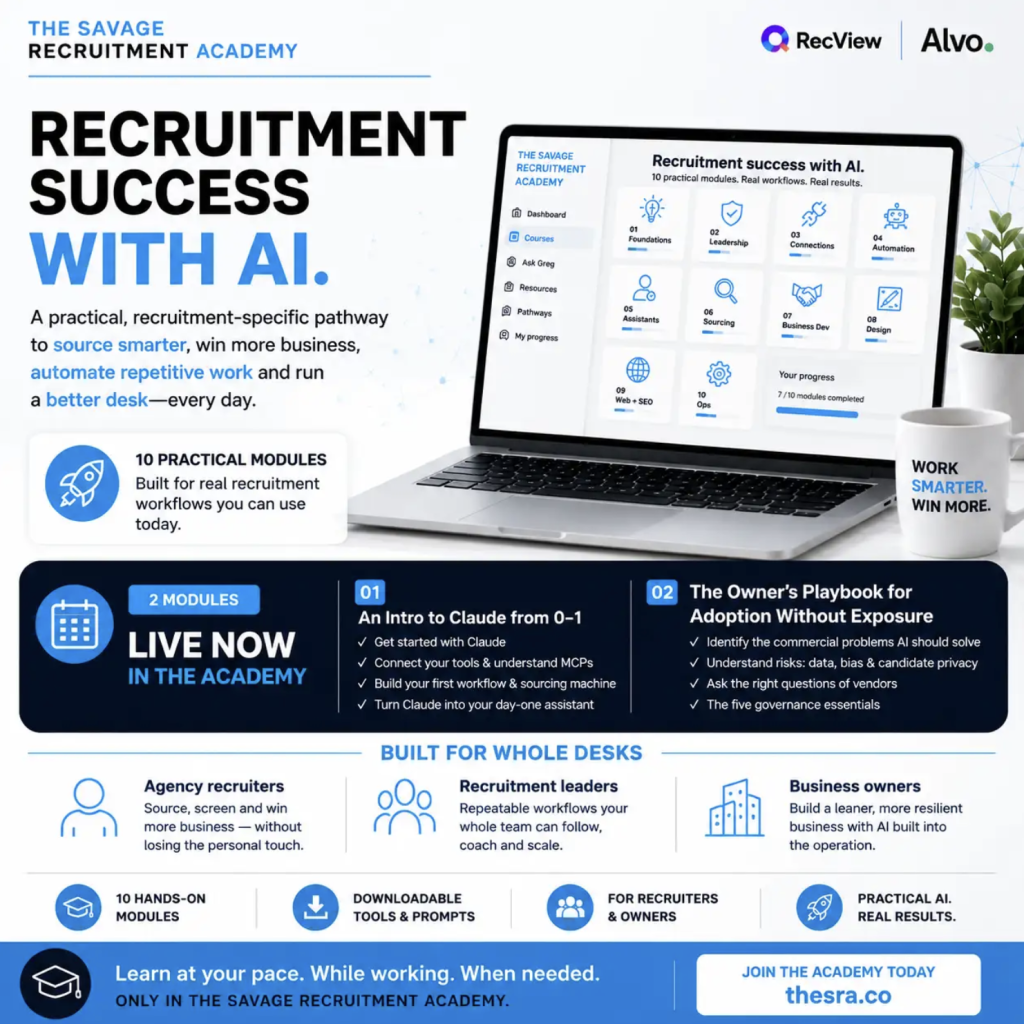
Course Brochure here
Sign up here
All 10 modules ‘live’ on the SRA
- Posted by Greg Savage
- On November 3, 2026
- 0 Comment