
The truth about ‘fillable’ job-orders
One of the most misunderstood skills in recruitment is qualifying a job order.
Not taking a job order. Not writing it down. Definitely not getting it by email and starting to work on it!
Qualifying it.
Turning a fantasy into something you can actually fill.
Diagnosing the the outcomes needed by the client and constructing a person profile to match it.
It is a consultative, advisory conversation where you bring your insights and influencing skills to finesse the requirements in the interests of getting the job accurately defined – and then filled with a candidate who can perform the required tasks.
Because here’s the truth every recruiter must learn early:
No job description on earth can’t be massaged, finessed, challenged, or changed. ( OK, maybe some hyperbole, but you are unlikely ever take one that cannot be qualified)
Clients don’t send job descriptions.
They send wish lists.
Wish lists which are likely based on a flawed understanding of the actual job that needs to be done!
Their ‘ideal’ candidate — the perfect human with 12 essential criteria — does not exist. And you know that. You’ve never placed someone who ticked all 12 boxes. No one has.
If you know the desired candidate profile is impossible to find, or the job description itself is flawed, you can influence the creation of the job order. A good recruiter finds the three or four absolute deal-breakers—the non-negotiables.
Everything else is noise.
Watch the video snippet from the Savage Recruitment Academy training library, and read the full story below
The JD says, “Salary capped at $100k.”
Is it?
Usually not. Ask the question. ( But the ask is subtle. It’s a slow ride. Check the advice on the Academy.)
The JD demands a double degree from Sydney Uni and experience in equity trading at Macquarie Bank.
Is that who you’ll place?
Almost certainly not.
Qualifying a job order means shaping it into something ‘fillable ‘— something grounded in reality, not corporate fantasy. It’s the difference between recruiters who send CVs and recruiters who make placements.
It’s a skilled diagnosis based on your experience to work out what needs to be done and what skills and expertise are required to deliver on that, for the client
And it’s not about ‘tricking the client’ into making the job easier for you to fill
It’s the reverse, actually. It is advising the client through your knowledge, experience and insights to help them come up with a JD that matches the task to be done, and the outcomes required, but that is also achievable in the candidate marketplace.
Why embark on a talent search that pays $100k when you know the market rate is $120k?
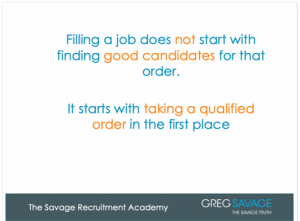
Great recruiters don’t just ‘take‘ job orders.
They interrogate them, reshape them, and make them fillable. And it’s a skill most recruiters lack. Which is a worry because it’s the type of consultative skill that is now becoming essential – not a “nice to have.”
Because the job you fill is rarely the one described in the job description you were originally given.
*****************************
The video above is a short snippet from the 200 + hours of recruitment training available on the Savage Recruitment Academy
Subscriber of the SRA?
Six hundred fifty recruitment companies have subscribed to the Academy. If you are a subscriber and wish to view the entire original video that this snippet is based on, you can view it here.
Not yet a subscriber to the SRA?
If you are not an SRA subscriber, please consider joining. Access the website for a list of contents, platform demo and pricing Here.
Sign up for the SRA here
*****************************************************************************************************************************************
Free webinar
June 18th
Sign up here
Live Q and A. Have your question answered on recruiter skills and strategies for your recruitment business to thrive

- Posted by Greg Savage
- On June 9, 2026
- 0 Comment